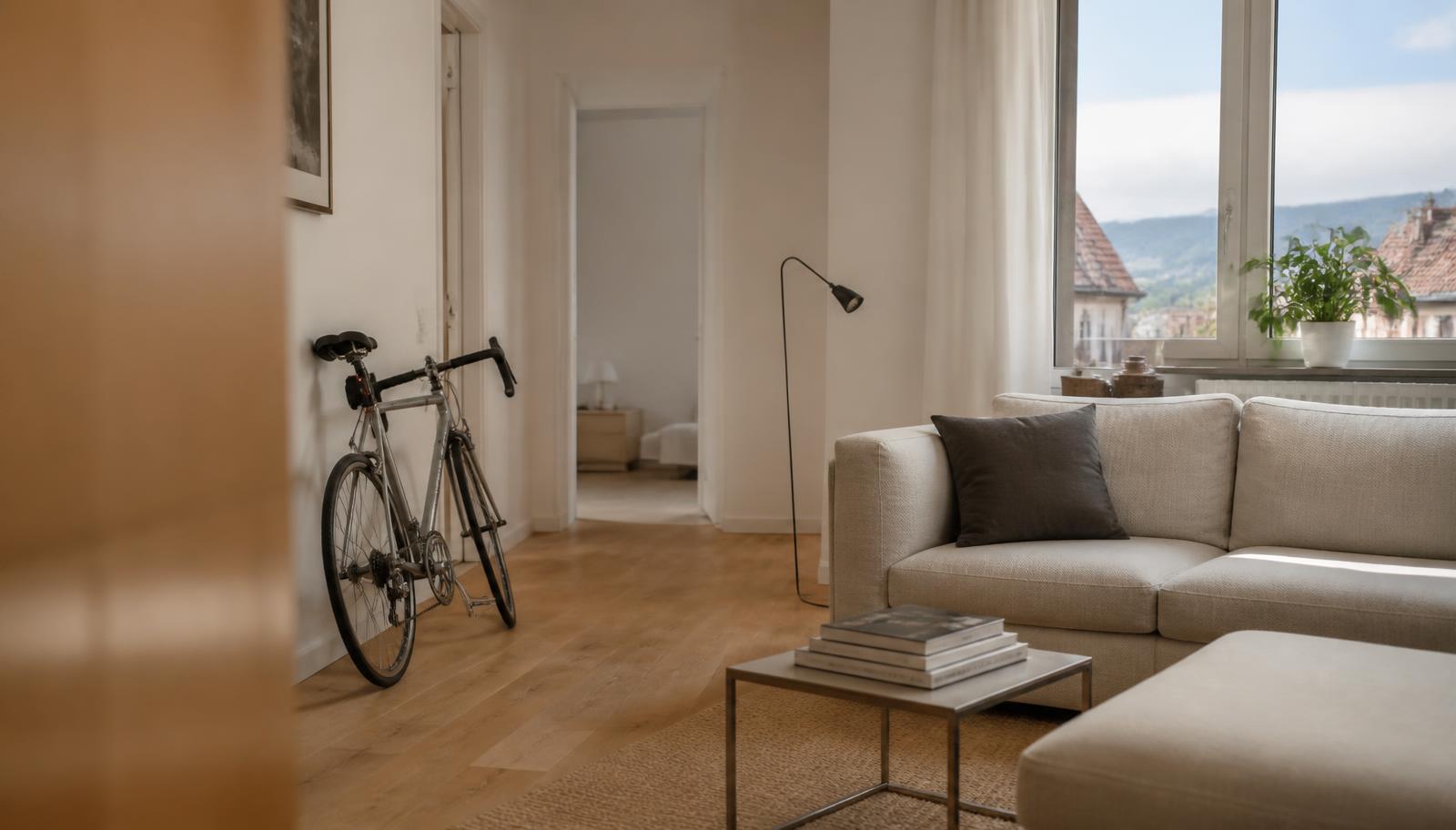
Household contents insurance (Hausratversicherung / assurance ménage) covers the movable belongings inside your Swiss home — furniture, clothing, electronics, bicycles, kitchen equipment and similar items — against fire, water damage, natural hazards, theft and glass breakage. It is a private contract under the Swiss Insurance Contract Act (VVG/LCA) and is voluntary in most cantons, although a few cantons require it and many landlords expect it in practice.
It is not the same as building insurance, which protects the structure itself, and it is not personal liability insurance, which pays for damage you cause to other people or their property. Most Swiss households hold contents and liability cover together, in one combined policy.
Key takeaways
- Household contents insurance protects what you own inside your home, not the building itself.
- It is governed by private contract law (VVG/LCA), so cover, exclusions and prices differ between insurers.
- A small number of cantons make contents cover compulsory; elsewhere it is voluntary but widely held.
- The sum insured should reflect the replacement value of everything you own — under-insurance is the most expensive mistake.
- Theft away from home, bicycles, valuables and glass are usually optional add-ons rather than automatic cover.
- It is normally bought together with personal liability insurance, which many Swiss landlords ask for before handing over the keys.
What household contents insurance actually covers
A standard Swiss contents policy insures your movable property against a defined list of perils. The details vary by insurer, but the core is remarkably consistent.
| Peril | Typical examples | Usually included? |
|---|---|---|
| Fire | Fire, smoke, lightning, explosion | Yes, in the standard cover |
| Water | Burst pipes, leaking washing machine, backflow | Yes, in the standard cover |
| Natural hazards | Storm, hail, flooding, avalanche, rockfall | Yes, in the standard cover |
| Burglary and theft at home | Break-in, forced entry, robbery inside the home | Yes, in most standard policies |
| Simple theft away from home | Bag stolen from a train, laptop taken from a café | Optional add-on |
| Glass breakage | Windows, glass tables, hobs | Often optional |
| Bicycles and e-bikes | Stolen from a public bike rack | Usually needs to be named or added |
| Valuables | Jewellery, watches, art, collections | Covered only up to a sub-limit |
What is never covered by contents insurance: wear and tear, your own carelessness in the sense of gradual damage, damage you cause to someone else (that is liability cover), and the building fabric itself.
Contents, building and liability: three different policies
Confusing these three is the single most common source of unpleasant surprises after a claim.
| Policy | What it protects | Who normally needs it |
|---|---|---|
| Household contents (Hausrat) | Your movable belongings inside the home | Tenants and owners alike |
| Building insurance (Gebäudeversicherung) | The structure: walls, roof, fixed installations | Property owners only — compulsory in most cantons through the cantonal building insurer |
| Personal liability (Privathaftpflicht) | Damage you or your family cause to others | Every household; frequently requested by landlords |
If you rent, you never need building insurance — your landlord holds it. You do, however, need liability cover for damage you cause to the flat you live in, such as a scratched parquet floor or a damaged kitchen worktop.
Is household insurance compulsory in Switzerland?
In most cantons it is voluntary. A small number of cantons make household contents insurance compulsory for residents, and building insurance is compulsory in the large majority of cantons through a cantonal monopoly insurer. Because the rules are cantonal rather than federal, the only reliable answer for your own situation comes from your cantonal building insurance authority or your commune.
Two practical points matter more than the legal question:
- Many Swiss landlords and letting agencies require proof of personal liability insurance — and often contents insurance — as a condition of the tenancy agreement.
- Without contents cover, a single burst pipe or flat fire means replacing an entire household out of your own pocket.
Good to know: Building insurance and household contents insurance are separate contracts even where both are compulsory. Owning a flat with cantonal building cover does not insure your furniture.
How to set the right sum insured
Swiss contents policies are written on a replacement value basis: the insurer pays what it would cost to buy the item new today, not what you originally paid or what it is worth second-hand. Your sum insured therefore has to represent the cost of refurnishing your entire home from scratch.
The practical method:
- Walk through each room and note furniture, appliances, electronics, clothing, sports equipment and kitchen contents.
- Estimate the current new price of each category, not the second-hand value.
- Add storage areas most people forget: cellar, attic, garage, balcony and bicycle room.
- Round upwards rather than downwards.
Under-insurance is the trap. If your sum insured is materially lower than the true replacement value of your contents, an insurer may reduce the payout proportionally — including on small claims. A household insured for CHF 60,000 when the true value is CHF 120,000 can, in principle, see a claim settled at around half.
Deductible, and how it interacts with premiums
Most Swiss contents policies carry a fixed deductible per claim, commonly a few hundred francs. Raising it lowers the premium slightly, but contents premiums are modest to begin with, so the saving is usually small compared with the extra risk you carry on a claim. Choose the deductible you could comfortably pay on the day something goes wrong.
Expert Insight
Expert Insight — One important distinction is between theft at home and simple theft away from home. A standard policy generally pays after a break-in at your address, but a bag stolen from a restaurant, a phone taken on the train or a bicycle removed from a station rack often falls under the optional simple theft outside the home module, which carries its own separate limit.
In practice, this is where most disappointed claims arise: the cover exists, but it was never activated, or its limit is far below the value of the laptop, watch or e-bike involved. When comparing offers, compare the sub-limits for outside theft, bicycles and valuables — not only the headline premium.
Common mistakes
- Assuming the landlord's insurance covers your belongings. It covers the building, never your furniture.
- Insuring a sum that was accurate five years ago. Contents grow with each move, child and purchase.
- Buying contents cover without personal liability. The liability half is the one that protects you against genuinely large claims.
- Overlooking bicycles and e-bikes. High-value bikes often need to be listed individually.
- Keeping no proof of ownership. Photographs and receipts speed up settlement considerably.
- Forgetting to notify a change of address. Cover follows the insured address, and a move usually changes both the risk and the premium.
What this means for you
If you rent in Switzerland, the realistic minimum is a combined household contents and personal liability policy. If you own your home, add the cantonal or private building insurance required in your canton. Whichever applies, the amount of cover matters more than the brand: a correct sum insured and the right add-ons will determine what you actually receive after a loss.
Households arriving from abroad should treat this as part of the same administrative block as registering with the commune and arranging health insurance — see our guide to health insurance after moving to Switzerland for the mandatory side of that checklist, and the overview of which insurance policies are genuinely recommended in Switzerland to see how contents cover fits alongside the rest.
Before you decide: a short checklist
- Have you estimated the replacement value of everything in your home, including cellar and garage?
- Does the policy include simple theft away from home, and at what limit?
- Are bicycles, e-bikes and valuables covered to a limit that matches what you own?
- Is personal liability included, and is the sum insured at least in the millions?
- Does your tenancy agreement require proof of cover before move-in?
- Is the deductible an amount you could pay comfortably?
- Do you know the notice period and renewal date of the contract?
Frequently asked questions
Is household insurance mandatory for tenants in Switzerland?
In most cantons it is not legally mandatory, but a small number of cantons require it, and many landlords make contents and liability cover a condition of the tenancy. Check your cantonal rules and your rental contract.
Does household contents insurance cover damage I cause to my rented flat?
No. Damage to the flat itself falls under personal liability insurance, which is why the two are almost always bought together.
Are my belongings insured while I am travelling?
Only if the policy includes cover for items taken outside the home, and then only up to a specific limit. This is an optional module with most Swiss insurers.
What happens if I am under-insured?
The insurer may reduce the payment in proportion to the shortfall between the sum insured and the actual replacement value, even for a small claim.
Can I cancel a Swiss household insurance policy at any time?
No. Contents insurance is a private VVG/LCA contract with an agreed term and notice period, usually three months before the renewal date. A move, or a claim, can create an additional right of termination — read the general conditions of your specific policy.
Does contents insurance cover flood or storm damage?
Natural hazard cover — including storm, hail and flooding — is part of standard Swiss contents policies. The precise definitions and any limits are set out in the policy conditions.
Where to go from here
Household cover is usually the simplest part of a Swiss insurance set-up, and it is often bundled inefficiently with policies a household does not need. If you would like an independent view of your current contracts, you can arrange a free consultation with us and we will go through your cover together, without obligation.
To see the wider picture — including the errors that cost Swiss households most — read the most common Swiss insurance mistakes, or browse the full Knowledge Centre.
Official Swiss sources
- ch.ch (Swiss Confederation, cantons and communes) — Household insurance: ch.ch (reviewed August 2026)
- Fedlex — Federal Act on Insurance Contracts (VVG/LCA), SR 221.229.1: fedlex.admin.ch (reviewed August 2026)
- FINMA — Swiss Financial Market Supervisory Authority, insurance supervision: finma.ch (reviewed August 2026)
- Association of Cantonal Fire Insurers (VKG/AEAI) — cantonal building insurance overview: vkg.ch (reviewed August 2026)
This article provides general information about Swiss household contents insurance and does not replace personalised insurance, legal or financial advice. Cover, limits and cantonal obligations differ between insurers and cantons; always read the policy conditions that apply to your own contract.