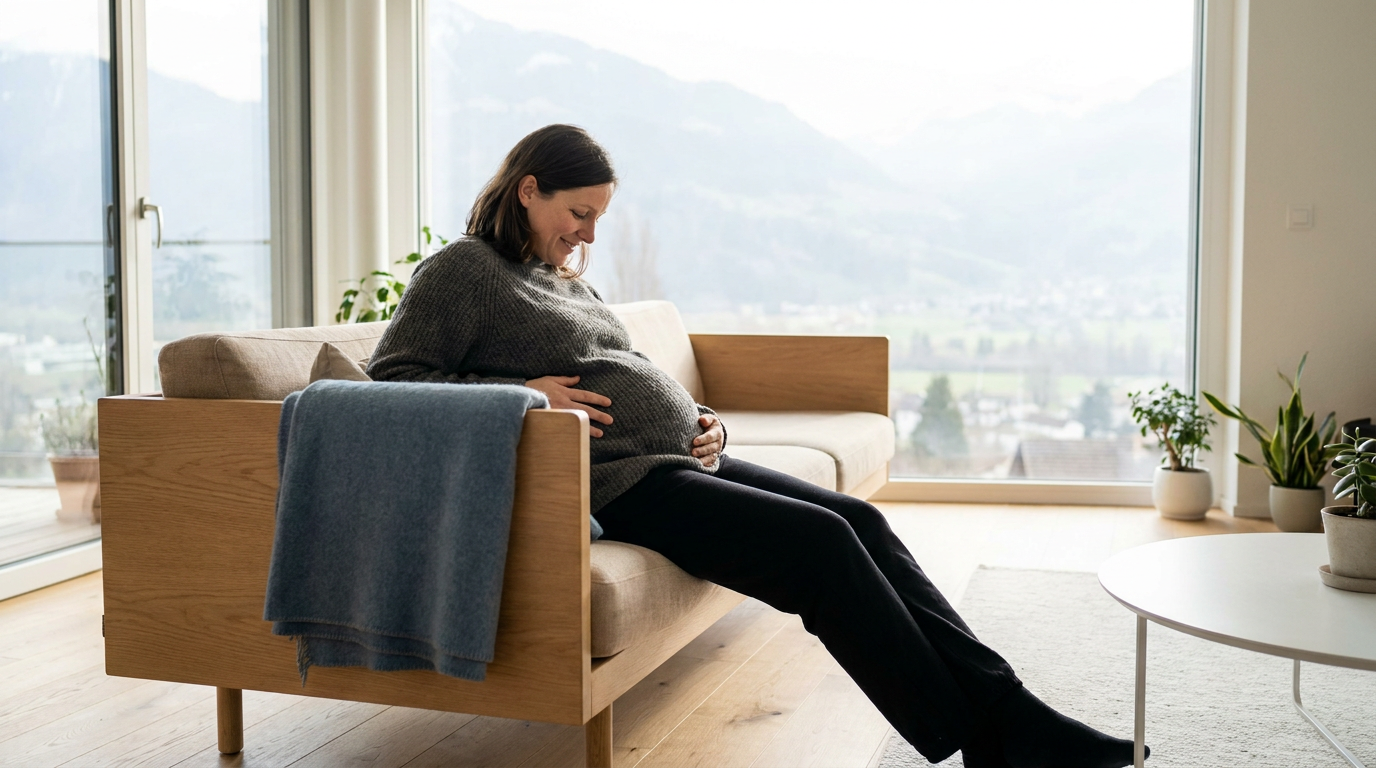
Maternity leave in Switzerland lasts 14 weeks, paid through a federal package of rights that protects a mother's income, job and health around childbirth. The core benefit is the federal maternity allowance (Mutterschaftsentschädigung) paid under the Loss-of-Earnings Compensation Scheme (EO/APG): 80% of your average pre-birth income for 14 weeks (98 days), capped at CHF 220 per day. Alongside it, Swiss law provides an eight-week work ban after birth, protection from dismissal, breastfeeding time at work, and a separate two-week allowance for the other parent. A few cantons, most notably Geneva, add their own top-up scheme. To qualify, you must have been insured under AHV/AVS for the nine months before the birth and have worked at least five of those months.
Key takeaways
The federal maternity allowance pays 80% of average earnings for 14 weeks (98 days), up to CHF 220 per day (maximum around CHF 21,560 in total).
To qualify, you must have been insured under AHV/AVS for the nine months before the birth and have worked at least five of those months.
The allowance stops early if you return to work before the 14 weeks are used up.
Employment law adds an eight-week ban on working after birth and a 16-week protection from dismissal.
The other parent receives a separate two-week (10 working days) allowance, also at 80% of earnings.
If your newborn is hospitalised for at least two weeks, the maternity allowance can be extended by up to 56 additional days.
Some cantons — including Geneva — pay a longer or higher cantonal maternity allowance on top of the federal one.
What "maternity benefits" actually cover in Switzerland
Switzerland does not have a single "maternity leave" law. Instead, several federal frameworks work together:
Loss-of-Earnings Compensation Act — pays the federal maternity allowance and the other-parent allowance.
Swiss Code of Obligations — protects your job and continues to require your employer to pay salary in certain cases.
Labour Act — sets the eight-week post-birth work ban, night-work restrictions and breastfeeding rules.
Federal Health Insurance Act (KVG) — covers pregnancy check-ups, delivery and post-natal care without franchise or co-payment from the 13th week of pregnancy.
Cantonal law — a small number of cantons add their own maternity or parental schemes.
Healthcare cover during pregnancy and birth is a separate topic. For a full walk-through, see our guide on pregnancy in Switzerland and the article on how much it costs to have a baby in Switzerland.
The federal maternity allowance at a glance
| Element | Federal rule |
|---|---|
| Duration | 14 weeks (98 consecutive days), starting on the day of birth |
| Amount | 80% of average gross earnings before the birth |
| Daily cap | CHF 220 per day (maximum ≈ CHF 21,560 in total) |
| Paid by | The AHV/AVS compensation office (Ausgleichskasse) |
| Applies to | Employees, self-employed mothers and, under conditions, unemployed mothers |
| Early end | Any return to paid work — even part-time — ends the allowance |
The allowance is taxable income and AHV/AVS, IV/AI and EO/APG contributions are deducted, just as with a salary.
Who is entitled to the maternity allowance
You are entitled to the federal maternity allowance if all of the following apply:
You have been compulsorily insured under AHV/AVS in the nine months immediately before the birth (this period is shortened if you moved to Switzerland during pregnancy from an EU/EFTA country, thanks to the coordination rules).
You were gainfully employed for at least five months during those nine months (employed, self-employed or working in your spouse's business against a cash salary).
On the day of the birth, you are still one of the following:
an employee,
self-employed,
working in your spouse's business for a cash salary, or
unemployed and receiving unemployment insurance benefits (or eligible to receive them).
Mothers who are not gainfully employed — for example, homemakers or students without an income — do not qualify for the federal allowance, although they still benefit from healthcare cover and employment-law protections where relevant.
How much you will actually receive
The daily allowance is 80% of the average gross income earned immediately before the birth, converted to a daily figure. The current daily maximum is CHF 220, which corresponds to a pre-birth income of roughly CHF 8,250 per month. Anything you earned above that ceiling is not reflected in the allowance.
As a rough illustration, a mother earning around CHF 6,000 per month receives roughly CHF 4,800 per month during the 14 weeks. Anyone earning well above the ceiling receives the same capped daily amount, regardless of how much higher their salary is.
Many employers pay more than the legal minimum — a full salary for part or all of the 14 weeks, or longer maternity leave — either voluntarily, through a collective labour agreement (Gesamtarbeitsvertrag / CCT) or under a public-sector staff regulation. Check your employment contract, staff handbook and any applicable CLA.
How long the leave lasts and when you can go back to work
Two different rules apply to the time after birth:
Allowance duration: 14 weeks of paid allowance, starting on the day of birth. It ends earlier if you resume paid work.
Work ban: Under the Labour Act, you are not allowed to work at all during the eight weeks after birth. Between weeks 9 and 16, you may only return to work with your explicit consent.
In practice this means most mothers take the full 14 weeks. Going back to work before week 15 — for example, at week 12 — is legally possible, but it terminates the maternity allowance entirely for the remaining days. There is no partial or pro-rated allowance for a phased return.
When the leave can be extended
Hospitalised newborn: If your baby has to stay in hospital for at least two consecutive weeks immediately after birth, the maternity allowance can, on request, be postponed and extended by up to 56 additional days (a maximum of eight weeks). You must plan to return to work at the end of the extended leave.
Death of the mother: If the mother dies during or after birth, the surviving father or the mother's spouse is entitled to an extended allowance in her place.
Health insurance during pregnancy: what you actually pay
Maternity allowance replaces income. Your medical costs are a separate system, handled by basic health insurance (KVG/LAMal) — and the rules are more generous than most parents expect.
Maternity-specific care carries no cost-sharing. Routine check-ups in an uncomplicated pregnancy, the standard ultrasound scans, midwife care, delivery in a hospital or birthing centre, and breastfeeding advice are covered without franchise and without the 10% co-payment.
From the 13th week of pregnancy until eight weeks after the birth, that exemption is extended to all treatment — including illness that has nothing to do with the pregnancy. Before week 13, ordinary illness costs still count towards your franchise as usual.
Supplementary cover is a separate decision. A semi-private or private room, free choice of doctor, or extras such as certain birth-preparation courses sit outside basic insurance. Insurers may decline or restrict maternity supplements once you are already pregnant, which is why this decision belongs early in the pregnancy — ideally before it.
Your baby needs a policy of their own. The child is insured in their own right from the day of birth; registering within three months makes cover retroactive to that date. Our baby health insurance guide sets out the sequence.
Employment protection around birth
Dismissal: Your employer cannot terminate your contract during pregnancy and for 16 weeks after birth. A dismissal issued during this period is null and void.
Reduced or unsafe work: Pregnant employees and new mothers must be moved to safer duties where their work involves particular risks. If no equivalent role exists, the employer must continue to pay at least 80% of the salary.
Night and long shifts: From the eighth week before birth, work between 8 pm and 6 am is prohibited. Employers must offer an equivalent daytime role or pay 80% of the salary.
Breastfeeding: During the child's first year, breastfeeding or expressing time counts as paid working time (in whole or in part, depending on the length of the working day).
Trial period and fixed-term contracts: Protection from dismissal does not apply during a trial period, and a fixed-term contract simply ends on its expiry date, even during pregnancy.
Maternity benefits for the self-employed
Self-employed mothers are covered on the same terms as employees, provided the AHV/AVS insurance and five-months-of-work conditions are met. The allowance is calculated on the income used to set your AHV/AVS contributions (typically the previous year's business income), again capped at CHF 220 per day.
Because self-employed mothers usually have no employer top-up, the maternity allowance is often their only source of income during the 14 weeks. This is a strong argument for reviewing daily-sickness (Krankentaggeld) and income-protection cover well before pregnancy.
The two-week allowance for the other parent
Since 1 January 2021, the father, the mother's registered partner or her wife (in the case of a same-sex married couple where the child is legally recognised) is entitled to a two-week paid leave, also paid at 80% of earnings (capped at CHF 220 per day).
The leave must be taken within six months of the birth.
It can be taken as two consecutive weeks or as individual days.
The same nine-month AHV/AVS insurance and five-months-of-work conditions apply.
An adoption leave of two weeks, paid on the same basis, exists for parents adopting a child under the age of four. For the full picture — how the ten days can be split, what happens with several employers, and how unpaid parental leave works in practice — see our guide to paternity leave and parental leave in Switzerland.
Cantonal top-ups: Geneva is the main exception
Geneva is the only canton running a general cantonal maternity scheme on top of the federal allowance. Everywhere else, extra weeks or full salary come from your employer or a collective labour agreement rather than from cantonal law.
| Element | Federal rule | Geneva (cantonal supplement) |
|---|---|---|
| Paid leave | 14 weeks | 16 weeks (2 additional cantonal weeks) |
| Daily amount | 80% of income, max CHF 220 per day | Cantonal supplement can bring the daily allowance to at least CHF 69 and up to CHF 329.60, depending on income |
| Extra condition | 9 months AHV/AVS + 5 months of work | At least 5 months of gainful activity on Geneva territory at the time of the birth |
| Newborn hospitalised | Up to 8 extra weeks (22 weeks in total) | Up to 28 weeks in total |
Source: Office cantonal des assurances sociales (OCAS), Geneva. If you live or work in another canton, your cantonal compensation office and your employer's staff regulations are the two places to check.
How to claim: a simple timeline
During pregnancy — inform your employer in writing, ideally in the second trimester, and discuss the return-to-work plan.
Before the birth — download the maternity-allowance claim form from your cantonal AHV/AVS compensation office or ask your employer for it.
After the birth — submit the completed form together with the child's birth certificate. Employees usually submit through their employer; the self-employed and unemployed submit directly.
Payment — the compensation office pays the allowance either to your employer (who continues your salary) or directly into your account.
Claim deadline — the entitlement lapses if the claim is not filed within five years of the end of the leave, but claiming early avoids cash-flow gaps.
Expert Insight
A common misunderstanding is that maternity benefits and maternity healthcare are the same thing. They are two separate systems. The maternity allowance replaces income and is paid by the AHV/AVS compensation office; maternity healthcare (check-ups, birth, post-natal care) is covered by basic health insurance under KVG, with no franchise or co-payment from the 13th week of pregnancy until eight weeks after birth. Confusing the two often leads parents to worry about medical bills that are actually already covered — or to overlook an important supplementary health-insurance decision before the baby is born. Our article on baby insurance before birth explains how to handle this in practice.
Common mistakes and misconceptions
Assuming leave is always six months. The federal minimum is 14 weeks. Anything longer is a matter of your employer's rules or cantonal law.
Assuming the allowance continues if you go back part-time. Any resumption of paid work terminates the allowance for the remaining days.
Overlooking the five-months-of-work rule. Being AHV/AVS-insured is not enough on its own; you must also have been gainfully employed for at least five months during pregnancy.
Confusing federal and cantonal benefits. Only a few cantons pay more than the federal minimum. Do not assume Geneva-style rules apply elsewhere.
Forgetting the other parent's two weeks. Many eligible fathers and partners never claim, especially if their employer does not remind them.
Ignoring supplementary cover before pregnancy. Insurers can decline or restrict supplementary maternity cover once you are already pregnant. Decisions taken before conception have very different consequences from those taken later.
What this means for your family
For most families, the federal maternity allowance covers a meaningful share — but not all — of the mother's pre-birth income for 14 weeks. Plan your household budget on that basis, and treat any employer top-up, unused holiday or unpaid extension as an addition rather than the norm. If both parents work, coordinate the mother's 14 weeks with the other parent's two-week allowance and any additional leave to keep at least one adult with the baby for as long as possible. Self-employed parents should look at their income-protection setup before pregnancy, not during it. Once the income side is planned, the next step is cover for the child itself — our Baby Insurance guide explains what to arrange before and just after the birth.
Before you decide
Have you checked your employment contract and any collective labour agreement for maternity provisions beyond the federal minimum?
Do you know your cantonal compensation office and where to download the claim form?
Have you confirmed that you meet the nine-month AHV/AVS and five-months-of-work conditions?
Have you discussed the other parent's two-week leave with their employer?
If self-employed, have you reviewed your daily-sickness and income-protection cover?
Have you separated income-replacement planning (this article) from healthcare cover and baby insurance planning?
Quick Summary
Maternity benefits in Switzerland combine federal regulations protecting a mother's income, job, and health, alongside provisions for the other parent. This guide details the 14-week federal allowance, eligibility criteria, employment rights, and supplementary cantonal schemes.
Frequently Asked Questions
What is the federal maternity allowance in Switzerland?
The federal maternity allowance pays 80% of your average pre-birth income for 14 weeks (98 days). It is capped at CHF 220 per day, with a maximum total payment of approximately CHF 21,560. This allowance helps compensate for loss of earnings during the maternity period.
Who is eligible for the federal maternity allowance?
To be eligible, you must have been insured under AHV/AVS for the nine months immediately before the birth and have worked for at least five of those months. On the day of birth, you must be employed, self-employed, or receiving unemployment benefits. Homemakers or students without income generally do not qualify.
How long is the work ban after childbirth in Switzerland?
Under the Labour Act, mothers are not permitted to work at all during the eight weeks immediately following childbirth. Between weeks 9 and 16, they may return to work with explicit consent. Returning to paid work before the 14 weeks are used up will terminate the maternity allowance entirely.
What are the maternity benefits for the other parent?
Since January 1, 2021, the other parent (father, registered partner, or spouse in a same-sex marriage) is entitled to two weeks of paid leave. This leave is also paid at 80% of earnings, capped at CHF 220 per day, and must be taken within six months of the birth.
Does health insurance cover pregnancy and birth costs?
Yes, under the Federal Health Insurance Act (KVG), pregnancy check-ups, delivery, and post-natal care are covered. From the 13th week of pregnancy, these costs are covered without requiring you to pay a franchise or co-payment. This ensures access to essential medical care during the maternity period.
Are self-employed mothers entitled to maternity benefits?
Self-employed mothers are entitled to the federal maternity allowance under the same conditions as employees, provided they meet the AHV/AVS insurance and five-months-of-work criteria. The allowance is calculated based on their income used for AHV/AVS contributions, capped at CHF 220 per day.
How long is maternity leave in Switzerland?
Federal maternity leave lasts 14 weeks (98 days) from the day of the birth and is paid at 80% of your previous income, capped at CHF 220 per day. Separately, employment law forbids you from working during the first eight weeks after the birth. Geneva adds two cantonal weeks (16 in total), and many employers or collective agreements go beyond the minimum.
Do I have to pay a deductible for pregnancy and childbirth?
No for maternity-specific care: check-ups, standard scans, midwife care and the delivery itself are exempt from the franchise and the 10% co-payment. From the 13th week of pregnancy until eight weeks after the birth, the exemption covers all treatment, including illness unrelated to the pregnancy.
Where to go from here
Maternity benefits are only one part of a much bigger picture that also includes healthcare cover, baby insurance and household budgeting. Most parents find it helpful to work through these decisions in a calm, unhurried order rather than all at once. Our insurance timeline for new parents in Switzerland sets out a gentle month-by-month sequence.
If, after reading, some questions still feel open — how your employer's rules interact with the federal allowance, whether your supplementary cover is right, or how to plan the first year financially — you are welcome to book a free, no-obligation conversation. There is no sales pressure; the aim is simply to make sure you feel confident about the choices ahead.
Official Swiss sources
Federal Social Insurance Office (FSIO/BSV) — Loss-of-earnings compensation and maternity insurance.
Swiss Confederation — Maternity leave and maternity benefit (ch.ch).
State Secretariat for Economic Affairs (SECO) — Maternity protection at work.
AHV/IV information centre — Maternity benefit information sheets.
République et canton de Genève — Cantonal maternity and adoption allowance.
This article provides general information about Swiss maternity benefits and does not constitute personalised legal, tax, insurance or medical advice. Federal figures and rules are those in force at the time of publication; always confirm current amounts with the relevant Swiss authority before acting on them.