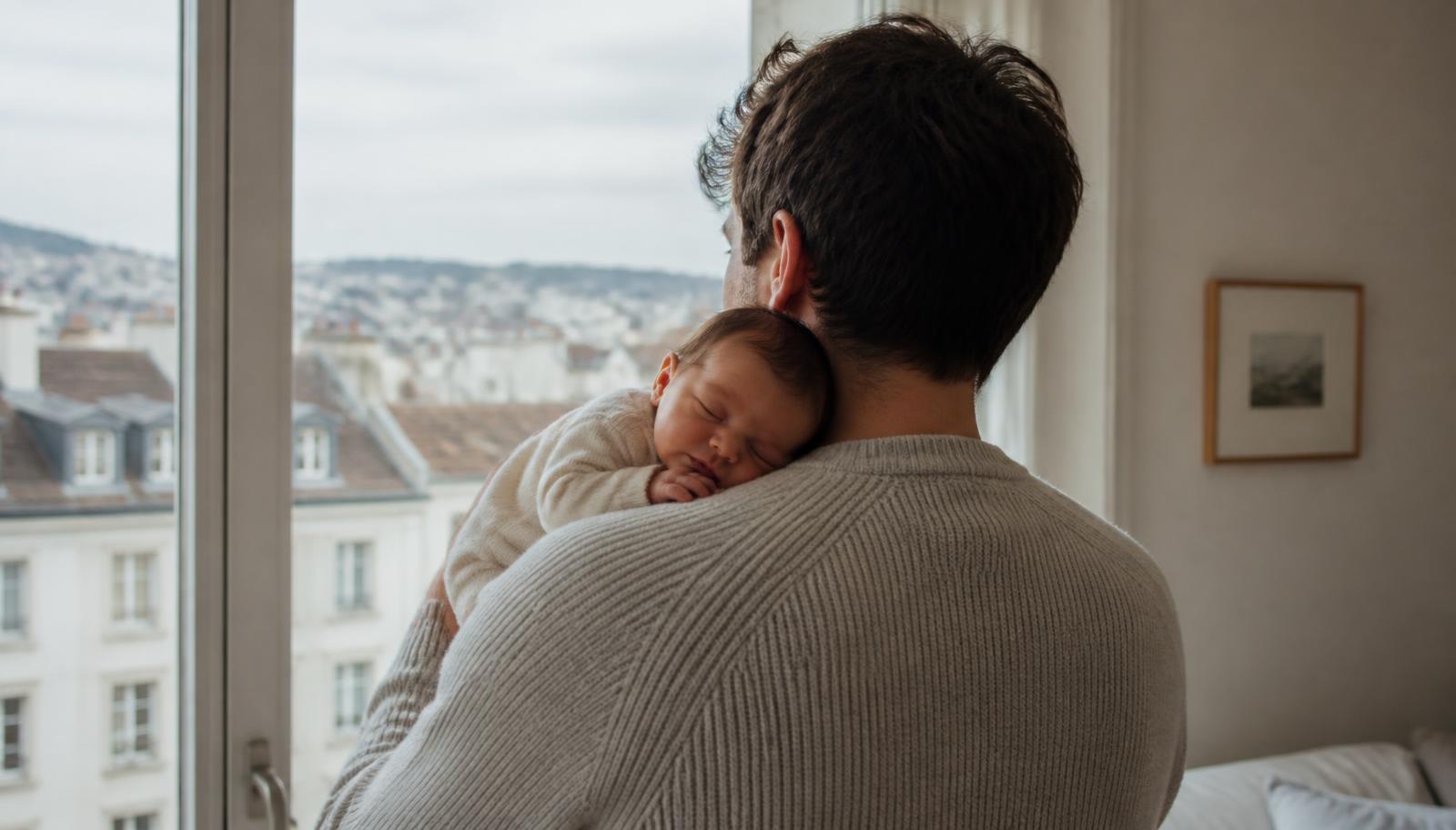
Switzerland does not have a general parental leave scheme. What the law gives the other parent — in most families, the father — is two weeks of paid leave after the birth of a child, paid at 80% of average earnings, capped at CHF 220 per day, through the federal Loss-of-Earnings Compensation scheme (EO/APG). The leave must be taken within six months of the birth, and it can be taken in one block or day by day. Alongside it, Swiss law provides two weeks of adoption leave, up to 14 weeks of carer's leave for a seriously ill child, and short paid absences to care for family members. Anything beyond that — longer leave, topped-up pay, shared months at home — depends entirely on your employer or collective agreement.
Key takeaways
- The other parent is entitled to two weeks (10 working days) of paid leave under Art. 329g of the Swiss Code of Obligations.
- Pay is 80% of average earnings before the birth, capped at CHF 220 per day — the cap is reached at a monthly salary of about CHF 8,250.
- Full-time employees receive 14 daily allowances for 10 days of leave, because weekends are compensated too.
- The leave must be used within six months of the birth; unused days are simply lost.
- There is no federal parental leave in Switzerland. Longer or better-paid leave comes only from an employer, a collective labour agreement or, in limited cases, cantonal rules.
- Your holiday entitlement cannot be reduced because you took this leave.
- Adoptive parents get two weeks of adoption leave for a child under four, shared between the parents.
What Swiss law actually grants new parents
Several separate entitlements are often lumped together under the English phrase "parental leave". In Switzerland they are distinct rights, with different durations, different qualifying rules and different funding.
| Leave | Duration | Paid by | Legal basis |
|---|---|---|---|
| Maternity leave | 14 weeks (98 days) | EO/APG at 80%, max CHF 220/day | Art. 329f CO |
| Leave for the other parent ("paternity leave") | 2 weeks (10 working days) | EO/APG at 80%, max CHF 220/day | Art. 329g CO |
| Adoption leave | 2 weeks, shared between both parents | EO/APG at 80%, max CHF 220/day | Art. 329j CO |
| Carer's leave for a seriously ill or injured child | Up to 14 weeks within 18 months | EO/APG carer's allowance | Art. 329i CO |
| Short leave to care for a family member | Max. 3 days per event, 10 days per year | Employer (continued salary) | Art. 329h CO |
| General parental leave | Does not exist at federal level | — | — |
Maternity benefits are a topic of their own, with their own eligibility test and employment protections. If that is what you are researching, start with our guide to maternity benefits in Switzerland rather than this page.
Who qualifies for the two weeks of paid leave
The entitlement is not automatic. Two conditions must both be met on the day the child is born.
Your relationship to the child. You qualify if you are:
- the legal father at the time of the birth, or you become the legal father within the following six months (for unmarried couples, through acknowledgement of paternity); or
- the mother's wife, recognised as the other parent under Art. 255a of the Swiss Civil Code.
Your insurance and work record. You must have been:
- insured under the OASI/AHV scheme for the nine months immediately before the birth (shortened for premature births); and
- gainfully employed for at least five of those nine months; and
- in gainful employment on the day of the birth — as an employee, as a self-employed person, or in one of the equivalent situations listed by the compensation offices, such as receiving unemployment or daily sickness benefits.
Periods of insurance and employment in an EU or EFTA state, or in the United Kingdom, count towards the nine and five months. This matters for people who moved to Switzerland partway through the pregnancy. If you arrived recently, it is worth reading how the wider social-insurance picture changes after a move in our guide to health insurance after moving to Switzerland.
How much you are paid, and who pays it
The allowance is a daily allowance equal to 80% of your average income before the birth, subject to a maximum of CHF 220 per day. The ceiling is reached at a monthly salary of CHF 8,250 for employees, or an annual income of CHF 99,000 for the self-employed.
The counting is not intuitive. A full-time employee taking all ten working days receives 14 daily allowances, because the two intervening weekends are compensated as well. The maximum payout is therefore CHF 3,080 (14 × CHF 220).
Worked example. An employee earning CHF 7,000 per month takes the full two weeks. The daily allowance is CHF 7,000 × 0.8 ÷ 30 = CHF 186.65, paid 14 times — around CHF 2,613 in total. An employee earning CHF 12,000 per month hits the cap and receives CHF 3,080, roughly 45% of two weeks' salary rather than 80%.
The claim is normally submitted through your employer to its OASI compensation office (Ausgleichskasse / caisse de compensation); self-employed parents claim directly. If your employer continues to pay your salary during the leave, the allowance is paid to the employer instead of to you. Many employers top the allowance up to 100% of salary, but that is a contractual benefit, not a legal right — check your employment contract or staff regulations before you plan around it.
How and when the two weeks can be taken
The rules on timing are more flexible than most new parents realise.
- The leave may be taken in full weeks or day by day — for example, two separate weeks, or ten single days spread across several months.
- It must be taken within six months of the birth. Days not taken by then are forfeited.
- Part-time employees receive a pro-rated number of days corresponding to their level of employment.
- You must inform your employer, but the leave is a legal entitlement: it is not at the employer's discretion in the way ordinary holiday is.
Two special situations extend these rights considerably. If the mother dies on the day of the birth or in the following 14 weeks, the other parent is entitled to 14 weeks of leave, taken consecutively from the date of death. If the newborn is hospitalised, that extended leave can be lengthened by up to eight further weeks.
Job protection, holidays and notice periods
Unlike the mother, the other parent does not benefit from a protection period against dismissal after the birth. Two safeguards do apply, however:
- Your holiday entitlement may not be reduced because you took this leave (Art. 329b para. 3 CO).
- If your employer terminates the contract before you have used the leave, the notice period is extended by the number of untaken days (Art. 335c para. 3 CO), so the entitlement is not lost through the dismissal.
Is there parental leave in Switzerland beyond the two weeks?
Not as a federal right. Several political initiatives to introduce a shared parental leave have been debated, but no general federal parental leave scheme is in force. In practice, longer time at home comes from three sources:
- Employer policies. Larger employers, particularly in pharma, banking, technology and the public sector, increasingly offer four to sixteen weeks for the second parent, often at full pay.
- Collective labour agreements. Some sector agreements grant more than the legal minimum; the agreement applicable to your industry, not your goodwill negotiation, decides.
- Cantonal schemes. A small number of cantons — Geneva being the best-known example — pay supplementary cantonal benefits on top of federal maternity or adoption allowances. These schemes differ by canton and are administered by the cantonal compensation office, so check yours directly rather than assuming a national rule.
Everything else is unpaid: unpaid leave, a temporary reduction in workload, or holiday taken around the birth. Each of these has knock-on effects worth thinking through — a lower salary during unpaid leave reduces OASI-relevant income and pension-fund contributions for that period.
Expert Insight
A common misunderstanding is that the two weeks are "the father's holiday" and can be saved for later. They cannot. The entitlement expires six months after the birth, and unlike annual holiday it cannot be carried over, paid out or converted into cash. Families who plan the two weeks for the end of the mother's 14-week maternity leave sometimes discover the window has almost closed.
One further distinction is often missed: taking the leave day by day rather than in a block can be the better practical choice for part-time or variable-income earners, because a single day of childcare cover late in the six months is often worth more to the family than a second consecutive week immediately after the birth.
Common mistakes
- Assuming the employer will handle the claim automatically. Most do, but the compensation office needs a completed form and salary certificate; a forgotten submission delays payment by weeks.
- Waiting to acknowledge paternity. Unmarried fathers must be recognised as the legal parent within six months of the birth to qualify.
- Budgeting for 80% of salary. Above roughly CHF 8,250 per month, the CHF 220 daily cap means the real replacement rate is lower.
- Confusing this leave with maternity leave rights. There is no work ban and no dismissal-protection period for the other parent.
- Overlooking the newborn's own insurance while on leave. The baby needs their own basic health insurance from birth, and supplementary cover is easiest to arrange before the birth — see baby insurance before birth.
What this means for your family
Two weeks is short. The practical question for most couples is not whether to take the leave — you should, it is paid and it expires — but how to combine it with the mother's 14 weeks, holiday, and any employer scheme so the child has continuous care during the first months.
A pattern that works well for many families: the other parent takes one week immediately after the birth and keeps the remaining days for the transition when maternity leave ends and childcare begins. If both employers offer more than the legal minimum, sequencing the two schemes rather than overlapping them usually buys the most time at home.
The administrative side runs in parallel with these decisions. Our insurance timeline for new parents sets out what has to be registered, and by when, from pregnancy through the first years.
Before you decide: a short checklist
- Confirm you meet the nine-month insurance and five-month employment conditions, counting any EU/EFTA or UK periods.
- Check your employment contract, staff regulations or collective agreement for leave beyond the legal two weeks.
- Ask your HR department which compensation office handles the claim and what it needs from you.
- Agree the timing pattern with your employer in writing, and diarise the six-month deadline.
- Ask whether your employer tops up the allowance to full salary, and calculate the shortfall if it does not.
- Register the newborn's health insurance and review family cover in the same period.
Frequently asked questions
How long is paternity leave in Switzerland?
Two weeks, equal to ten working days for a full-time employee. The leave must be taken within six months of the birth and may be taken in whole weeks or single days.
How much does the other parent get paid during the leave?
80% of average earnings before the birth, capped at CHF 220 per day. A full-time employee taking all ten days receives 14 daily allowances, so the maximum total is CHF 3,080.
Can the two weeks be transferred to the mother or saved for later?
No. The entitlement belongs to the other parent, expires six months after the birth and cannot be carried over, transferred or paid out in cash.
Does Switzerland have shared parental leave?
No general federal parental leave exists. Longer or shared leave is available only where an employer, a collective labour agreement or a specific cantonal scheme provides it.
Do self-employed parents qualify?
Yes, provided the insurance and employment conditions are met. Self-employed parents claim the allowance directly from their OASI compensation office rather than through an employer.
What applies if we adopt a child?
Adoption of a child under four gives an entitlement to two weeks of adoption leave, to be taken within twelve months and shared between the parents, who may not take it at the same time.
What happens if our baby is seriously ill?
Parents of a child whose health is seriously impaired by illness or accident can claim carer's leave of up to 14 weeks, taken within 18 months and split between both working parents.
Is the allowance taxable and does it count for my pension?
Yes. The allowance is treated as income, OASI/AHV, DI and loss-of-earnings contributions are deducted, and it is recorded in your individual account, so it counts towards your future pension.
Where to go from here
Leave entitlements are only one half of the picture in the weeks around a birth; the other half is making sure the child and the family are properly insured before the deadlines start running. If you would like an independent view of your own situation, you can request a free personal consultation, or read what needs to be arranged before the birth on our baby insurance page.
Official Swiss sources
- Information Centre OASI/DI — Leaflet 6.04: Allowance for the other parent (father or mother's wife): ahv-iv.ch/p/6.04.e (accessed 8 August 2026).
- Information Centre OASI/DI — Leaflet 6.02: Maternity allowance: ahv-iv.ch/p/6.02.e (accessed 8 August 2026).
- Information Centre OASI/DI — Leaflet 6.11: Adoption allowance: ahv-iv.ch/p/6.11.e (accessed 8 August 2026).
- Fedlex — Swiss Code of Obligations (SR 220), Art. 329b, 329f, 329g, 329h, 329i, 329j and 335c: fedlex.admin.ch (accessed 8 August 2026).
This article provides general information about Swiss leave entitlements and social insurance. It is not legal, insurance, tax or financial advice, and it does not take account of your individual employment contract, collective agreement or cantonal rules. Figures reflect the officially published values verified on 8 August 2026.